

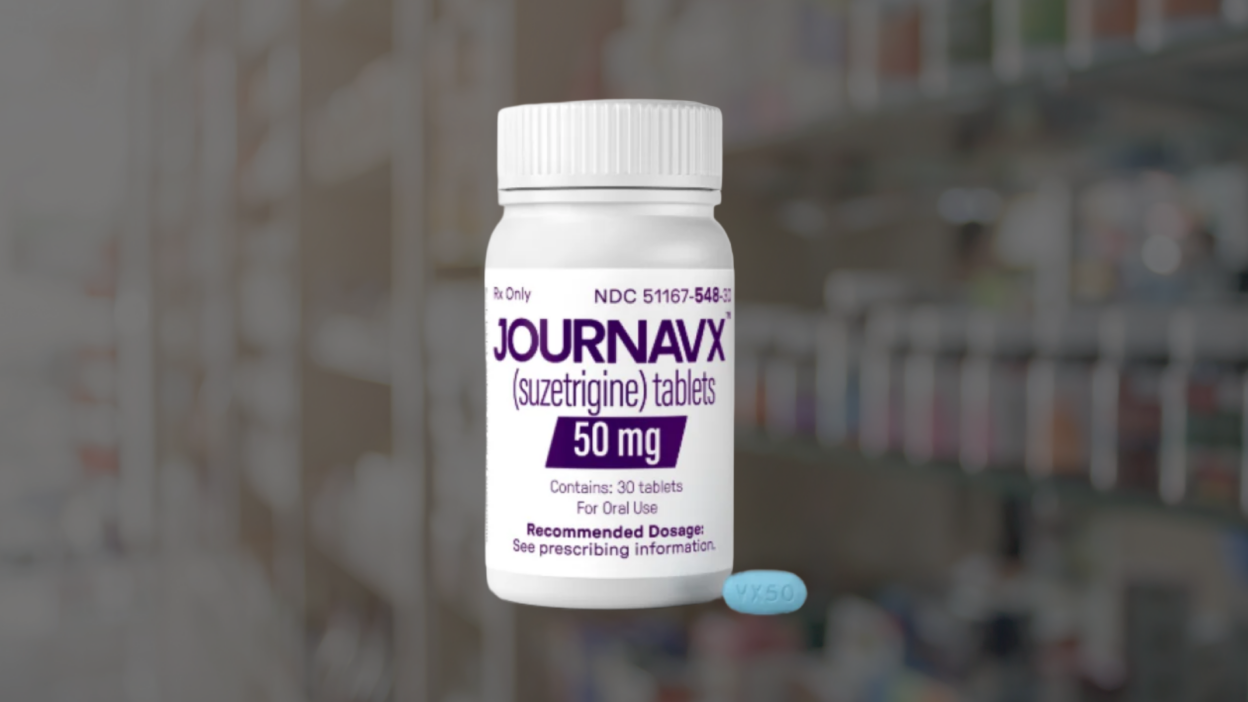
Suzetrigine (Journavx; Vertex Pharmaceuticals) just crossed a threshold that signals it is no longer an early-adopter drug. It is becoming a mainstream acute pain management option, and the questions from patients and prescribers are arriving at pharmacy counters right now.
The Numbers That Define Where This Drug Is
In the second quarter and first six months of 2026, approximately 535,000 and approximately 900,000 prescriptions, respectively, have been filled for Journavx across the hospital and retail settings. Approximately 260 million individuals in the U.S. now have reimbursed access to Journavx across a wide range of commercial and government payers. Twenty-three states provide coverage for Journavx via Medicaid.
June run-rates hit roughly 100,000 monthly prescriptions in each of the hospital and retail channels. The company added about 18,000 prescribers and now has Journavx on 1,400 hospital and 130 IDN pathways.
Revenue reached $50 million in Q2, representing 71% sequential quarterly growth and more than quadrupling the $12 million from Q2 2025. Vertex expects its non-CF product revenues to exceed $500 million in 2026, with Journavx as a primary driver.
The trajectory is unmistakable. Suzetrigine is transitioning from a first-in-class therapeutic novelty to an increasingly routine option in acute pain care.
The Mechanism Every Pharmacist Must Own Before the Next Prescription
The pharmacist who cannot explain suzetrigine’s mechanism clearly in the next 60 seconds will lose the patient’s confidence and the clinical opportunity simultaneously. Here is the explanation.
Suzetrigine selectively blocks NaV1.8 sodium channels. These channels are expressed preferentially in peripheral sensory neurons, specifically the nociceptors that detect and transmit pain signals from the body to the brain. By blocking NaV1.8 specifically, suzetrigine interrupts pain signal transmission at the peripheral sensory nerve level, before those signals reach the central nervous system.
This selectivity is what makes suzetrigine fundamentally different from every other analgesic currently in clinical use. Opioids act in the central nervous system on mu-opioid receptors in the brain and spinal cord, producing analgesia alongside sedation, respiratory depression, constipation, and euphoria, the properties that create both their therapeutic value and their addiction risk. NSAIDs inhibit COX enzymes throughout the body, producing analgesia alongside GI mucosal damage, platelet inhibition, renal vasoconstriction, and cardiovascular risk. Suzetrigine acts at the peripheral sensory nerve level and produces none of those central or systemic off-target effects.
The patient-facing explanation: “This is a pain medication that works differently from opioids. It blocks pain signals at the nerve level, in your body, before they reach your brain. That means no sedation, no risk of becoming dependent, and none of the stomach or kidney concerns that come with ibuprofen or naproxen.”
That explanation, delivered in 15 seconds, answers the three questions every patient has when they see a drug they’ve never heard of on their prescription.
The Real-World Evidence That Arrived This Quarter
Real-world evidence in support of Journavx continues to build, including the recent publication of “Suzetrigine as Part of Multimodal Therapy Enables Opioid-Free Recovery After Aesthetic or Reconstructive Procedures,” in the journal Plastic and Reconstructive Surgery.
That publication is clinically significant because it moves suzetrigine’s evidence from controlled trial conditions into an actual surgical setting, demonstrating opioid-free recovery as an achievable outcome in elective procedures when suzetrigine is integrated into a multimodal pain management protocol. The opioid stewardship connection this newsletter documented last week is direct: suzetrigine’s real-world performance in surgical settings provides the data that perioperative pharmacist-led opioid stewardship programs can now reference when proposing non-opioid protocol alternatives.
The Drug Interaction That Will Be Missed Without a Pharmacist Review
Suzetrigine functions as a mild CYP3A inducer. This single pharmacokinetic property generates a specific, clinically significant drug interaction that requires pharmacist review at every prescription fill.
Mild CYP3A induction accelerates the metabolism of substrates that depend on CYP3A4 for their clearance. The most clinically consequential suzetrigine interaction in the outpatient setting involves hormonal contraception: specifically, the prescribing information advises patients using hormonal contraceptives containing progestins other than levonorgestrel or norethindrone to use additional nonhormonal contraceptive methods during suzetrigine therapy and for 28 days after discontinuation.
This is the interaction that gets missed. A woman receiving suzetrigine for post-surgical pain who uses a progestin-only pill with a progestin other than levonorgestrel or norethindrone, or a combined oral contraceptive with a progestin in the affected class, could experience reduced contraceptive efficacy during a course of suzetrigine therapy without any warning unless the dispensing pharmacist reviews her complete medication profile.
The mechanism: mild CYP3A induction accelerates metabolism of progestins metabolized via CYP3A4, reducing their plasma levels and potentially reducing their contraceptive efficacy. Levonorgestrel and norethindrone are specifically exempted in the prescribing information because their metabolic pathways are less dependent on CYP3A4.
This counseling point takes 20 seconds. It requires looking at the full medication profile before dispensing. It is the specific function that positions the pharmacist as the clinical safety checkpoint no prescriber can replicate at discharge or at the prescription write.
The Access Reality That Diverges from the Coverage Headline
Practical availability may diverge from “covered lives” because tiering, prior authorization, institutional protocols, discharge logistics, inventory, and cost sharing can delay treatment in time-sensitive acute pain.
The primary bottleneck to prescription growth is physician education on minor restrictions like quantity limits and prior authorizations, which currently triggers the Vertex patient support program more than forecast.
The gap between 260 million covered lives and the prescription reaching the patient in a time-appropriate manner is exactly where pharmacist expertise produces the highest immediate value.
The patients most likely to benefit most from suzetrigine, those with opioid use disorder history, elderly patients at highest risk from opioid sedation and respiratory depression, patients on concurrent CNS depressants, are also the patients most likely to face formulary barriers, quantity limits, or prior authorization requirements that create delay.
A pharmacist who understands the quantity limit requirements on their specific formularies, knows which payers have suzetrigine on which tier, and can identify when a prior authorization is required and complete it proactively provides a clinical service that directly determines whether that high-benefit, high-risk patient accesses the non-opioid option or defaults to an opioid prescription that was never the right choice.
Vertex’s patient support program exists specifically to navigate these barriers: VxGo is a comprehensive patient support program that provides financial assistance and reimbursement navigation for suzetrigine. The pharmacist who knows VxGo’s enrollment process and routes appropriate patients into it removes a cost-sharing barrier that might otherwise produce an opioid fill instead.
The Cost-Effectiveness Context
Suzetrigine’s wholesale acquisition cost is higher than generic opioids and generic NSAIDs. That comparison, if limited to acquisition cost, understates the drug’s economic value in specific patient populations.
ICER modeling suggests cost-effectiveness at wholesale acquisition cost if short opioid courses produce two or more additional cases of opioid use disorder per pharmacoeconomic assumption set.
For the patient with documented opioid use disorder history, the patient on opioid maintenance therapy, the patient with COPD or sleep apnea who cannot tolerate opioid-related respiratory depression, and the elderly patient at high fall risk from opioid sedation, suzetrigine’s acquisition cost premium is justified by the avoided outcomes that would follow an opioid prescription. These are exactly the patients for whom a pharmacist-initiated suzetrigine conversation carries the most clinical and economic weight.
The Opioid Stewardship Integration This Drug Demands
This newsletter covered pharmacist-led opioid stewardship in depth in the previous issue, including the VA pilot data showing 1,290 preoperative interventions for 289 patients and 63.3% naloxone prescribing rates when a clinical pharmacist systematically reviewed risk.
Suzetrigine’s expanding availability adds a specific new dimension to that perioperative stewardship function. For appropriate patients scheduled for surgical procedures where moderate-to-severe acute post-operative pain is anticipated, suzetrigine now represents a pharmacist-initiatable conversation at the preoperative or discharge stage that can prevent an opioid prescription entirely, not just mitigate its risk.
The preoperative pharmacist encounter documented in the VA study included pharmacotherapy recommendations for 59 patients preoperatively. Suzetrigine now belongs in the pharmacotherapy recommendation checklist for those encounters when the patient’s risk profile makes an opioid alternative clinically appropriate.
Your Counseling Protocol Starting Today
For every suzetrigine prescription you fill, three counseling elements are non-negotiable.
Mechanism explanation in plain language. 15 seconds. Blocks pain signals at the nerve, not in the brain. No sedation, no dependence, no GI or kidney risk. Patients who understand why this drug is different stay on the therapy and report their experience accurately.
CYP3A contraceptive interaction screen. Pull the full medication profile. Identify hormonal contraception. Determine the progestin component. If it is not levonorgestrel or norethindrone, deliver the additional contraceptive method counseling and document it. This is the interaction that creates adverse outcomes when missed and demonstrates clinical expertise when caught.
Quantity limits and prior authorization navigation. Know which formularies require PA for suzetrigine in your payer mix. Build the PA checklist for the most common payers in your market. For patients facing cost-sharing barriers, route them to VxGo. For patients who are being discharged from a hospital with a suzetrigine prescription, confirm that your retail pharmacy has inventory before the patient drives to your counter.
And for the patients who walk in with an opioid prescription for acute post-surgical, dental, or musculoskeletal pain: one question. “Has your prescriber discussed any non-opioid pain options with you?” That question, asked consistently at the point of opioid dispensing for acute pain, is how the pharmacist becomes the last clinical checkpoint in the transition away from opioids as the default acute analgesic.
The drug that makes that checkpoint actionable just crossed one million prescriptions. Your patients are going to ask about it. Be ready before they do.
Sources: Vertex Pharmaceuticals Q2 2026 Earnings Press Release / Investor Relations (news.vrtx.com, August 3, 2026), BioSpace (Vertex Reports Second Quarter 2026 Financial Results), Pharmacy Times (Suzetrigine Nears 1 Million Prescriptions as Reimbursed Access Expands for Nonopioid Acute Pain Treatment, August 2026), Plastic and Reconstructive Surgery (Suzetrigine as Part of Multimodal Therapy Enables Opioid-Free Recovery After Aesthetic or Reconstructive Procedures, 2026), Vertex Pharmaceuticals JOURNAVX Prescribing Information (NaV1.8 mechanism, CYP3A interaction, contraceptive warning), Vertex VxGo Patient Support Program, ICER Suzetrigine Evidence Report (NaV1.8 Inhibition in Acute Pain), BigGo Finance / Yahoo Finance Q2 2026 Earnings Call Transcript Summary