

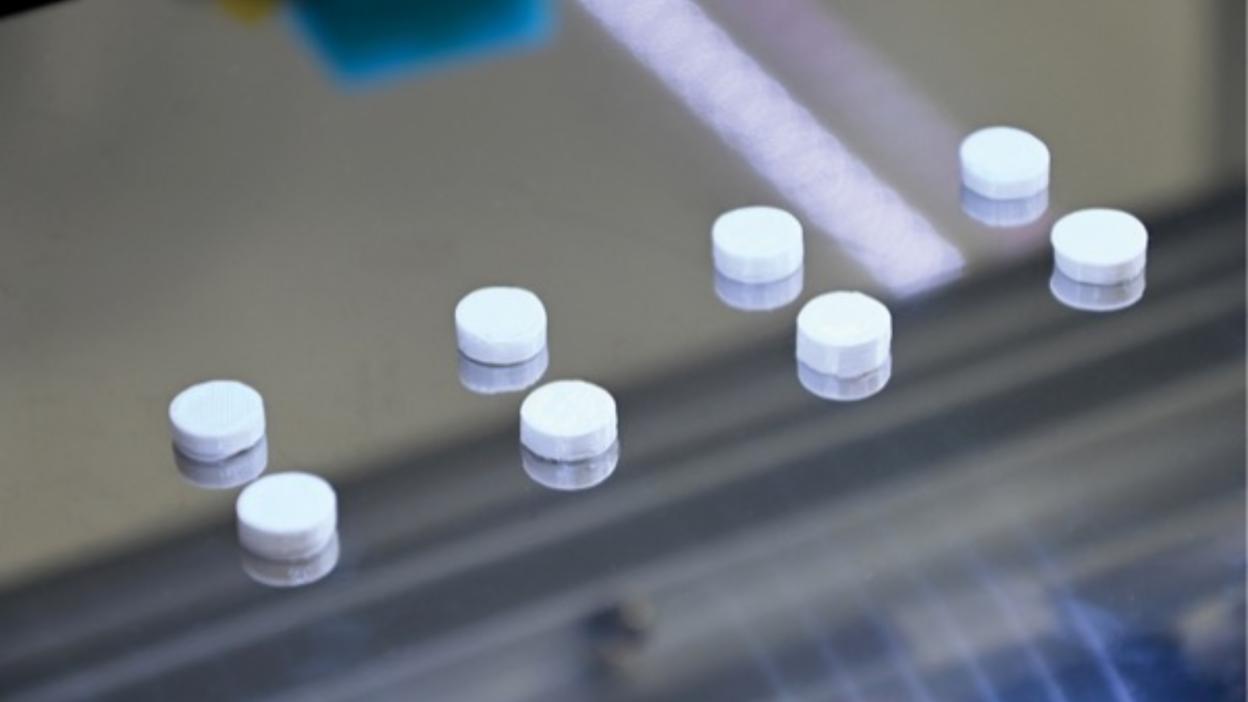
The story ASHP published last fall is one of the most genuinely exciting pharmacy innovation stories in years, and it hasn’t gotten nearly the attention it deserves. St. Jude Children’s Research Hospital is on track to become the first U.S. institution to implement semi-autonomous 3D pharmaceutical compounding for direct patient care. The pharmacist who led this work just published the data that makes that milestone credible.
What St. Jude’s Pharmacy Team Actually Did
A pilot study conceived and led by Brooke Beavers Bernhardt, PharmD, MS, FCCP, BCOP, BCPPS, chief pharmaceutical officer at St. Jude Children’s Research Hospital in Memphis, Tennessee, evaluated oral hydrocortisone formulations produced by a semisolid extrusion process using a modular 3D printing system. The study, co-authored with Cynthia A. Brasher and a team from CurifyLabs, was published in Pharmaceutics in June 2025 and covered by ASHP NewsCenter in September 2025.
Three formulations were evaluated: oral gel tablets at 3.2 mg, water-free troches at 2.8 mg, and orodispersible films at 1.2 mg. These doses represent concentrations typically used at St. Jude for pediatric patients. The target drug was hydrocortisone, a medication where dose precision is not optional, because these children are managing adrenal insufficiency, a condition where the difference between an adequate dose and an inadequate one can produce an adrenal crisis.
The study results demonstrated that all three oral hydrocortisone formulations reliably and reproducibly met U.S. and European Pharmacopeial criteria for mass and content uniformity.
That last sentence is the clinical bottom line. Not “the formulations were promising.” Not “results suggested potential.” They met pharmacopeial standards. Both U.S. and European. Reliably and reproducibly.
The Technology Behind the Result
The 3D printing platform uses a semisolid extrusion process, which is distinct from the fused deposition modeling that most people think of when they hear “3D printing.” Rather than building rigid plastic structures layer by layer from a solid filament, semisolid extrusion works with pharmaceutical-grade gels, pastes, and semi-solid matrices that are precise enough for clinical dosing.
The process St. Jude validated works in two phases. First, each production step, including mixing, dose production, packaging, and validation, was performed at the manufacturer’s facilities and validated against pharmacopeial standards. Second, the validated process was transferred to St. Jude in Memphis and reproduced using the same machine and protocols. “We were able to reproduce those same doses with that same concentration and strength, using the machine, no matter where we were,” said Brasher, describing the transferability validation that is a prerequisite for any clinical implementation.
Bernhardt described the technology’s relationship to existing pharmacy automation directly: “The 3D-printing technology replaces manual processes in nonsterile compounding in a way that’s loosely analogous to using robotics in sterile compounding.”
That analogy is precise and useful. When automated compounding robots entered sterile pharmacy practice, they didn’t replace pharmacists. They replaced the most error-prone, time-intensive, manual steps in IV preparation while increasing throughput and reducing contamination risk. The pharmacist’s role shifted from performing manual admixture to supervising, validating, and overseeing a more consistent and auditable process. The same transition is now proposed for nonsterile compounding.
Why Nonsterile Compounding Has Needed This for Decades
Pharmaceutical compounding remains a predominantly manual process with limited innovation, particularly in nonsterile applications. That description, from the Pharmaceutics paper’s own background section, is an understated indictment of how little the nonsterile compounding workflow has changed compared to sterile compounding.
Tablets and capsules are often difficult for children to swallow. Liquids may taste unpleasant or be inconsistently measured, leading to dosing errors. And while pharmacists have bridged these gaps through extemporaneous compounding for generations, the process remains time-intensive and inherently variable. Small differences in technique, equipment calibration, and ingredient sourcing can translate into meaningful dose variability for patients who need precision most.
The precision argument is the one that should resonate most deeply with clinical pharmacists managing pediatric oncology patients. When a child with acute lymphoblastic leukemia requires hydrocortisone as part of their steroid management protocol, a dose that is 15% above target is not merely imprecise. It is a clinical problem. The manual compounding process has never been able to eliminate that variability entirely. A 3D printing platform that meets pharmacopeial mass and content uniformity criteria every time, with the same result whether produced in Memphis or transferred to another institution, changes that baseline.
“For us, it opens the possibility of greater precision, improved medication adherence. It allows us to find better ways to deliver lifesaving medications to pediatric patients,” Bernhardt said.
The Formulation Options That Change Patient Experience
One of the most clinically undervalued dimensions of this technology is what it enables beyond precision: palatability and form factor customization.
St. Jude’s system can produce child-friendly formulations including dissolving films, mini-tabs, troches, and gummy tablets, with flavor options that make medicines more palatable. The study validated three distinct forms of hydrocortisone in a single platform. Each form addresses a different patient need.
Orodispersible films dissolve on the tongue in seconds without water, making them the preferred option for patients who cannot swallow or who require administration through a nasogastric tube. Water-free troches are held in the cheek or under the tongue, ideal for certain oncology patients with mucositis that makes swallowing painful. Oral gel tablets provide a familiar tablet form factor but with a soft, easily crushable structure for children who resist liquids but struggle with standard tablets.
The St. Jude program has also begun expanding beyond hydrocortisone. Bernhardt’s research group has published a follow-up study on automated 3D printing of ondansetron HCl dihydrate dosage forms, a critical antiemetic for pediatric oncology patients where commercial formulations are limited by rigid dosing options, unpleasant taste, and administration challenges that compromise adherence.
The same medication adherence failure mode this newsletter documented in the MASLD, ADA 2026, and RPM issues, patients not taking their medications consistently because of side effects, difficulty with administration, or palatability, is precisely what 3D printed customized formulations address at the point of care.
The Geriatric Application That Nobody Is Talking About
Most coverage of this technology frames it exclusively as a pediatric innovation. That framing misses half the clinical opportunity.
The same patient characteristics that make standard commercial formulations inadequate for children also describe a large proportion of elderly patients: swallowing difficulties, the need for lower or customized doses, intolerance of certain excipients, and administration challenges that create adherence failure. Dysphagia affects an estimated 8% of the general population but up to 68% of nursing home residents and significantly higher proportions of patients with neurological conditions including Parkinson’s disease, stroke, and dementia.
A 3D printing platform that produces orodispersible films and gel tablets customized to a specific dose for a specific elderly patient with dysphagia and polypharmacy is delivering the same core clinical value as the pediatric formulation: a medication that the patient can actually take, at the dose that is actually appropriate for them, in a form that doesn’t require them to crush a tablet they were told not to crush or swallow a liquid they reliably spit out.
Every compounding pharmacy serving long-term care facilities, memory care units, or home health patients has this clinical problem in their current patient panel. The technology being validated at St. Jude is not exclusively a children’s hospital solution.
The Regulatory and USP Compliance Architecture
Bernhardt’s team is not only validating the clinical performance of 3D printed formulations. They are simultaneously ensuring that the technology meets the regulatory requirements for pharmacy compounding, which is the piece that determines whether this scales from a research pilot to a clinical standard.
In addition to studying and validating 3D printing, the pharmacy team is ensuring that its use of the technology meets regulatory requirements for pharmacy compounding. The platform must comply with USP Chapter 795 standards for nonsterile compounding, which govern personnel training, facility requirements, formulation documentation, stability testing, and quality control procedures.
The transferability validation, producing the same results in Memphis that were initially validated at the manufacturer’s facility, is itself a key element of demonstrating that the technology can be implemented at a clinical site rather than only in a controlled manufacturing environment. That distinction matters enormously for FDA and state board of pharmacy review, since a compounding pharmacy operating under 503A or 503B regulations must demonstrate that its process is reproducible and controlled under the conditions actually present at its facility.
St. Jude is on track to become the first United States institution to introduce semi-autonomous and 3D pharmaceutical compounding for direct patient care. That milestone, when it formally occurs, will provide regulatory precedent that every other compounding pharmacy seeking to implement the technology can reference in its own USP compliance arguments.
The Commercial Technology Landscape Right Now
The CurifyLabs system St. Jude used in the published study is the ACTA platform, a semisolid extrusion 3D printing system designed specifically for pharmaceutical compounding. It has been in clinical use in Europe for longer than in the United States. European regulatory frameworks for pharmacy-based 3D printing of medications are more developed than the current U.S. framework, which is part of why St. Jude’s work establishing U.S. pharmacopeial compliance documentation is specifically valuable.
The University of Mississippi School of Pharmacy has been developing expertise and training resources in this area, which St. Jude credited with demonstrating the technology’s accessibility outside a pure research institution context. The University of Mississippi even offers coursework on 3D printing of medications, reflecting recognition that this is a clinical pharmacist skill of the near future, not an engineering discipline.
This is no longer a research curiosity. It is a clinical technology being validated at one of the most rigorous pediatric oncology institutions in the world, with peer-reviewed pharmacopeial data published in a major pharmaceutical sciences journal.
Your Action This Week
If you work in or near a compounding pharmacy setting, identify two things before Friday.
First, research where 3D pharmaceutical printing technology currently stands in terms of commercial availability in the United States. CurifyLabs, the company whose platform St. Jude used, is accessible to U.S. health systems and compounding pharmacies through their commercial distribution. Other platforms including M3DIMAKER are also available in certain healthcare settings. Understanding the current product landscape, including what USP compliance documentation the manufacturer provides and what additional site validation a 503A or 503B pharmacy would need to perform, is the baseline for evaluating whether implementation is feasible for your operation.
Second, review the Pharmaceutics paper published in June 2025 (doi: 10.3390/pharmaceutics17060762) alongside ASHP’s September 2025 coverage. The paper is open access. It describes the full two-phase validation process and the pharmacopeial testing methods in enough detail to understand what your own compounding pharmacy would need to replicate before CMS, FDA, or your state board would view the process as compliant.
The pharmacists who understand this technology now will be the ones implementing it when it becomes standard practice. That transition is closer than most compounding pharmacists currently estimate.
Sources: ASHP NewsCenter (St. Jude Pharmacists Explore 3D Printing of Medications, September 11, 2025), Pharmaceutics / MDPI (Bernhardt MB, Brasher CA et al. Automated 3D Printing-Based Non-Sterile Compounding Technology for Pediatric Corticosteroid Dosage Forms in a Health System Pharmacy Setting. Pharmaceutics. 2025;17(6):762. doi:10.3390/pharmaceutics17060762), PMC (Same article, open access full text), St. Jude Children’s Research Hospital (Personalized, Palatable, Precise: Transforming Pediatric Medication Delivery, 2025), St. Jude Research (Bernhardt Research Profile, ondansetron follow-up study), CurifyLabs (ACTA Platform Overview), Drug Topics (3D Printing of Medications: What Pharmacists Need to Know, 2026)