

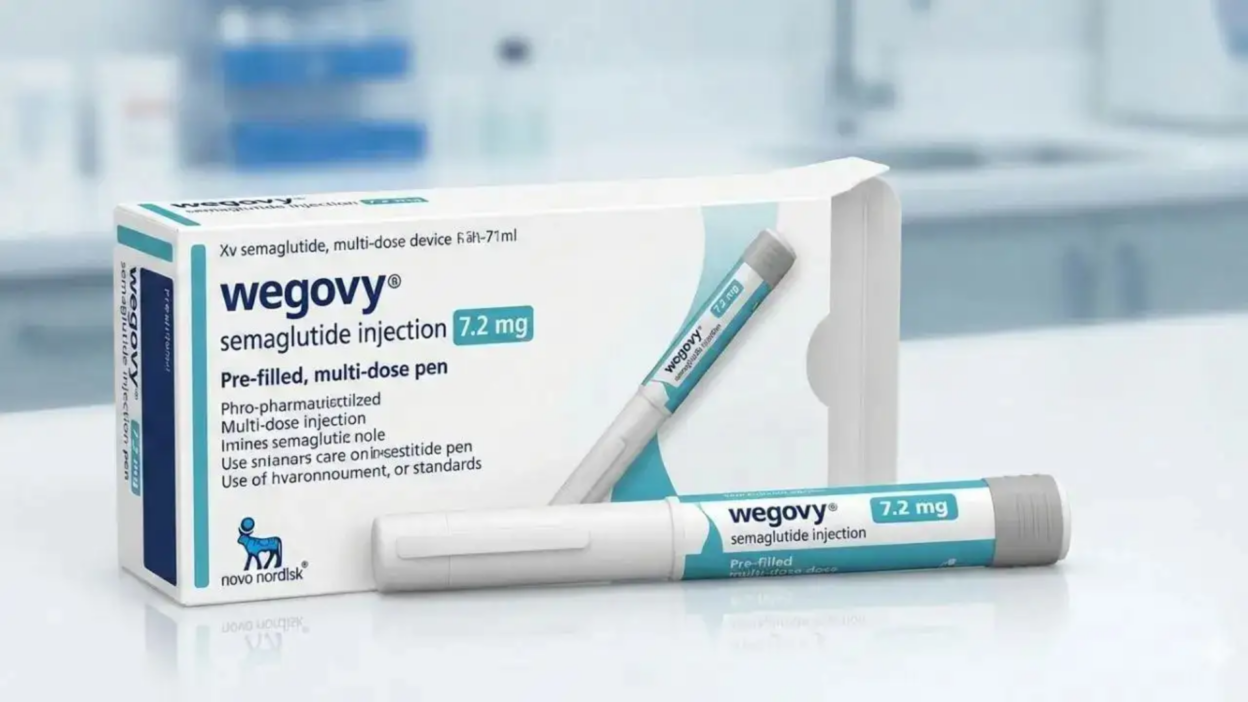
The highest-dose Wegovy ever approved is now available nationwide. The efficacy data is genuinely impressive. The new adverse effect signal that comes with it is something every pharmacist dispensing this product needs to actively counsel on, starting with the first fill.
What Just Launched
The FDA approved semaglutide injection 7.2 mg, Wegovy HD, from Novo Nordisk, to reduce excess body weight and maintain long-term weight reduction in adults with obesity or overweight with at least one weight-related condition. The product is available through the same channels as existing semaglutide formulations, including retail pharmacies, select telehealth providers, and specialty pharmacy services.
The approval marks the first GLP-1 receptor agonist approved under the Commissioner’s National Priority Voucher pilot program. FDA Commissioner Martin Makary stated at the time: “The new FDA is moving with unprecedented efficiency on products that advance national priorities. Today’s approval is another demonstration of what the FDA can accomplish when we try bold new things.”
Wegovy HD injection 7.2 mg is available now nationwide, delivering the highest weight loss of any Wegovy injection to date.
The Efficacy Data Driving Demand
The numbers behind this launch explain why patient interest will be high from day one.
Adults with obesity but without type 2 diabetes receiving semaglutide 7.2 mg in the STEP UP trial lost 20.7% of their body weight at 72 weeks, according to the efficacy estimand. Of the participants receiving semaglutide 7.2 mg, 31.2% lost 25% or more of their body weight at 72 weeks.
Average weight loss was approximately 21% at 72 weeks in adults with obesity if all patients stayed on treatment, and about one in three trial participants achieved 25% weight loss or higher.
For the harder-to-treat population of patients with both obesity and type 2 diabetes, the results addressed a phenotype that has historically responded less robustly to GLP-1 therapy. In the STEP UP T2D trial, patients receiving semaglutide 7.2 mg lost 14.1% of their body weight at 72 weeks, and 21.3% of adults lost at least 20% of their body weight. In STEP UP T2D, the 7.2 mg dose achieved 13.2% mean weight loss versus placebo.
Mike Doustdar, president and CEO of Novo Nordisk, framed the launch directly: “Earlier this year, we launched the Wegovy pill, and with the accelerated approval of Wegovy HD, we are introducing a new offering for our injectable semaglutide that provides even greater weight loss of approximately 21%.”
The Dysesthesia Signal: What the Data Actually Shows
This is the part of the Wegovy HD story that requires proactive pharmacist action, and it is genuinely new territory for the GLP-1 class.
The most common adverse reactions reported with Wegovy HD were nausea, vomiting, dysesthesia, constipation, abdominal pain, fatigue, headache, dizziness, hair loss, and flatulence. In clinical trials, dysesthesia was reported at a higher rate with Wegovy HD compared to semaglutide 2.4 mg and placebo.
The safety and tolerability profile was consistent with prior semaglutide trials and comparable with semaglutide 2.4 mg. During treatment, gastrointestinal events were the most common adverse events. However, a higher incidence of dysesthesia was noted with 7.2 mg, at 18.9%, versus 2.4 mg, at 4.9%, and placebo, at 0%, in STEP UP T2D.
Read those three numbers again. Zero percent on placebo. 4.9% on the standard 2.4 mg dose, the dose most current Wegovy patients are already on without this issue. 18.9% on the new 7.2 mg dose, nearly one in five patients.
This is not noise. This is a dose-dependent signal that did not exist at meaningful frequency at lower doses and now appears in roughly one in five patients escalating to the highest available dose.
Why This Specific Side Effect Is Different From Everything Patients Already Expect
Patients starting or escalating semaglutide therapy have been counseled, correctly, to expect gastrointestinal side effects. Nausea, constipation, and abdominal discomfort are familiar territory. Most patients on GLP-1 therapy have either experienced these symptoms themselves or have heard about them from friends, social media, or prior counseling.
Dysesthesia is different. Abnormal, often unpleasant sensations, tingling, burning, numbness, in the hands, feet, or elsewhere, are not symptoms most patients associate with a weight loss injection. A patient who develops new tingling in their fingers two weeks after escalating to Wegovy HD has no obvious reason to connect that sensation to their medication.
This creates a specific clinical risk. The patient may interpret new tingling or numbness as something alarming, unrelated to their treatment, perhaps neurological, perhaps a sign of nerve damage from undiagnosed diabetes, perhaps something requiring an urgent care visit. Or the patient may simply become anxious about the medication itself and quietly stop taking it, without mentioning the symptom to anyone, because they don’t know it is a known and usually temporary effect of the dose escalation.
Either outcome is preventable with one sentence delivered at the counter before the symptom occurs.
The Escalation Protocol That Matters as Much as the Drug Itself
Wegovy HD can be used along with a reduced calorie diet and increased physical activity to help adults with obesity lose weight and keep it off, provided they have tolerated the 2.4 mg dosage for at least four weeks and additional weight reduction is clinically indicated.
This labeling detail is the pharmacist’s clinical anchor for every Wegovy HD conversation. The 7.2 mg dose is not an initial therapy. It is an escalation step for patients who have already demonstrated tolerability at 2.4 mg and have a clinical indication for additional weight loss beyond what 2.4 mg has achieved.
That means every patient receiving a Wegovy HD prescription has, by definition, already been on 2.4 mg for at least four weeks. The pharmacist’s role at this transition point is threefold: confirm the escalation is appropriate based on the patient’s documented tolerability history, counsel proactively on the dysesthesia signal before the patient experiences it, and establish a clear communication pathway for the patient to report new symptoms rather than self-discontinuing.
The Counseling Script
Build this into your standard Wegovy HD dispensing workflow now, before patients start asking about unexplained tingling without knowing what to call it or that it’s connected to their medication.
The core framing: “You’re moving up to a higher dose of Wegovy, which research shows can provide more weight loss for patients who’ve tolerated the lower dose well. One thing I want you to know about ahead of time: some patients on this higher dose notice unusual tingling, burning, or numbness sensations, especially in the hands or feet. This is a known effect that shows up more often at this dose than at the dose you were on before. It’s usually temporary. But if you notice it, please don’t just stop the medication on your own, call us or your prescriber so we can help you through it and make sure it’s not something else.”
That single proactive conversation does three things. It normalizes the symptom if it occurs, reducing patient anxiety and the likelihood of an unnecessary urgent care visit. It establishes the pharmacist as the resource the patient turns to if the symptom appears, rather than the patient quietly discontinuing or searching the internet for answers. And it creates a documentation opportunity, if the patient calls back reporting dysesthesia, that call is itself a clinical encounter worth recording.
The FDA Is Still Watching This Signal
The FDA is investigating the dysesthesia signal associated with higher-dose semaglutide.
This newsletter covered the same signal in retatrutide’s Phase 3 data several issues ago, where dysesthesia rates reached 20.9% at the highest investigational dose. The pattern across the highest-dose formulations of multiple GLP-1 and multi-agonist therapies is becoming consistent: as dose intensity increases and weight loss magnitude increases, dysesthesia incidence rises in parallel. The mechanism remains incompletely understood, but the pattern across Wegovy HD and retatrutide’s Phase 3 program suggests this is a class-level signal tied to dose intensity, not an isolated finding specific to one molecule.
Pharmacists who understand this pattern across the class, not just for one drug, are positioned to recognize and counsel on dysesthesia regardless of which high-dose GLP-1 or multi-agonist a given patient is escalating to, now and as additional high-dose formulations reach the market over the next two years.
Your Action Before the Next Wegovy HD Fill
Update your dispensing workflow for any prescription marked Wegovy HD, semaglutide 7.2 mg, to trigger the dysesthesia counseling conversation automatically, the same way many pharmacies trigger automatic counseling for new anticoagulants or controlled substances.
Confirm the patient has documentation of tolerability at 2.4 mg for at least four weeks before the escalation, consistent with the FDA labeling. If that documentation isn’t visible in your system, a brief conversation with the patient, “How did the lower dose go for you, any side effects you were managing?”, both confirms appropriateness and opens the door to the dysesthesia counseling naturally.
Deliver the script. One sentence. Before the patient leaves the counter. The difference between a patient who experiences dysesthesia, recognizes it, calls your pharmacy, and continues effective therapy, and a patient who experiences the same symptom, panics or quietly discontinues, and loses the benefit of a medication that was working, is that one sentence.
Nearly one in five patients on this dose will experience this. Make sure all of them hear from you first.
Sources: Pharmacy Times (FDA Approves Higher-Dose Semaglutide Under Accelerated Review Program, May 7, 2026), AJMC (Higher-Dose Semaglutide Approved Under New FDA Accelerated Review Process), Healio (FDA Approves High-Dose Wegovy 7.2 mg for Adults With Obesity, March 19, 2026), HCPLive (FDA Approves Higher Dose Semaglutide, Wegovy HD, Injection 7.2 mg for Obesity), BioSpace / GlobeNewswire (Novo Nordisk: Wegovy HD Semaglutide 7.2 mg Approved in the US, Providing 20.7% Mean Weight Loss, March 19, 2026), PR Newswire (FDA Approves Novo Nordisk’s New Wegovy HD Injection, March 19, 2026; Novo Nordisk Files for FDA Approval of Higher-Dose Wegovy 7.2 mg), GlobeNewswire (CHMP Recommends EU Approval of Wegovy 7.2 mg in Single-Dose Pen, May 22, 2026), American Diabetes Association 85th Scientific Sessions (Wharton S et al., STEP UP Trial Poster 1966-LB, June 2025)