
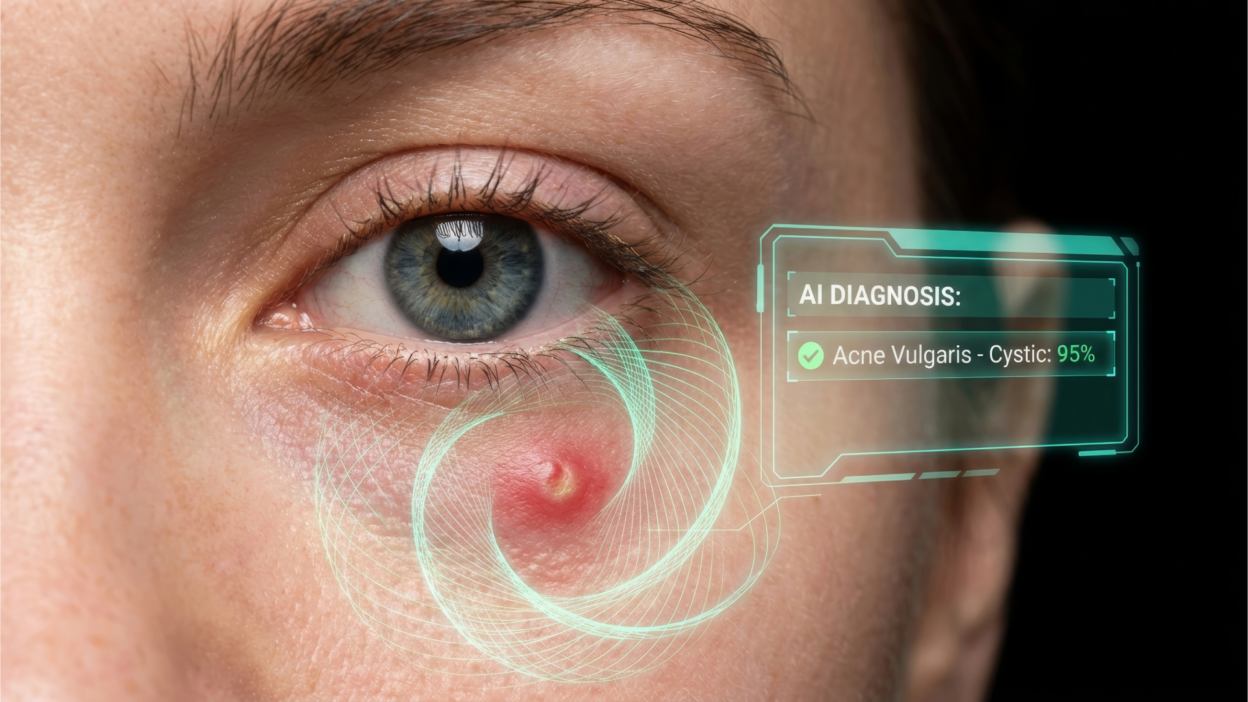
Imagine taking a few photos of your face, answering some health questions, and receiving a prescription for acne treatment without scheduling a doctor’s appointment.
That might sound like a glimpse into the future, but Utah is already testing it.
In October 2026, Nolla Health launched a state-authorized pilot that allows artificial intelligence to evaluate certain patients with acne and generate new prescriptions. For now, two licensed physicians must approve every prescription before it reaches the pharmacy. Eventually, the system could be allowed to prescribe without prior physician approval.
The medications are familiar acne treatments. What’s new is the role AI is beginning to play in deciding which medication a patient receives.
From a Selfie to a Prescription
Through Nolla Health’s smartphone app, Nolla Derm, patients upload facial images and answer questions about their medical history. The AI evaluates their acne and selects a treatment from eight preapproved topical medications.
The program is limited to Utah adults with mild to moderate acne. Severe acne, oral medications, and patients with certain medical risks fall outside its scope.
Utah has designed the pilot around gradually changing levels of physician oversight. During Stage 1, two Utah-licensed physicians review every AI-generated prescription before it reaches a pharmacy. Later stages may allow prescriptions to be issued directly, followed by physician reviews or periodic audits. Each transition requires state approval. As of October 19, The BMJ reported that Nolla remained in Stage 1.
This is also a step beyond Utah’s earlier Doctronic pilot, launched in January 2026, which focuses on renewing existing prescriptions. Nolla is testing whether AI can help initiate treatment for a new condition.
How Reliable Is AI at Diagnosing Acne?
The research is promising, although important questions remain.
A review by Frederickson and colleagues examined 105 studies involving AI in acne diagnosis and management. Average reported accuracy ranged from approximately 87% to 90%, depending on the type of model. However, only 13% of studies reported patient skin color, and just four studies (3.8%) included that data, limiting our understanding of performance across diverse populations.
Another systematic review by Choy and colleagues found a meaningful difference between identifying acne and assessing its severity. Median accuracy for diagnosing acne was 94%, while accuracy for grading acne severity ranged from 67% to 86% across four studies. This distinction matters because determining severity can influence which treatment a patient receives.
The review also identified important research limitations. Only 37.5% of studies evaluated algorithms using independent datasets, clinical settings, or prospective testing. Additionally, 92% were rated at high risk of bias, and 97% had high applicability concerns.
These findings don’t establish how accurately Nolla’s specific system performs. They highlight why real-world testing is essential before AI prescribing becomes more widely adopted.
What Happens When AI Starts Prescribing?
Utah’s authorization comes with safeguards, but it also raises questions that extend beyond acne treatment.
State officials require AI-generated prescriptions to be identified as such when sent to pharmacists, along with contact information for a physician who can answer questions. The company must also maintain professional liability insurance and report adverse events under the pilot agreement.
Yet broader legal questions remain unresolved. Some legal commentators have questioned whether federal prescription-drug laws permit an algorithm to act as a prescriber and whether AI prescribing software may require FDA medical-device authorization. State authorization does not automatically resolve federal regulatory requirements.
Liability is another important consideration. If an AI system selects an inappropriate medication, responsibility may involve the company, supervising physicians, or other parties depending on the circumstances. Existing malpractice frameworks were developed around human healthcare professionals, and how they apply to increasingly autonomous prescribing systems remains uncertain.
Why Pharmacists Should Pay Attention
For pharmacists, this development introduces an interesting possibility: prescriptions may increasingly originate from software operating under approved treatment protocols.
The pharmacist’s responsibility to evaluate medication safety and appropriateness remains important. But AI-generated prescriptions could introduce new workflows for verifying treatment decisions, resolving clinical questions, and communicating with the organizations operating these systems.
There are also opportunities beyond dispensing. Pharmacists could help design medication-selection algorithms, establish clinical safeguards, evaluate prescribing accuracy, and monitor medication-related outcomes.
These are areas where pharmaceutical knowledge and an understanding of real-world medication use can help shape how new healthcare technologies are developed.
A Small Pilot With Bigger Implications
Utah’s experiment is deliberately narrow. It involves a limited selection of topical acne medications and does not establish that AI can safely prescribe across more complex conditions.
Still, the progression is remarkable. AI has moved from answering health questions and supporting medical documentation to assisting with prescription renewals. Now, Utah is testing whether it can help initiate treatment.
The next questions involve safety, regulatory oversight, patient trust, and how these systems perform outside controlled environments.
For pharmacists, the opportunity is to participate in answering those questions and help shape how AI becomes part of medication management.
The experiment may have started with acne treatments, but its implications extend across the future of healthcare.
Resources
Utah Department of Commerce, Office of Artificial Intelligence Policy. AI Authorized Pilots: Nolla Health. Agreement signed September 22, 2026; pilot term October 5, 2026–October 5, 2027.
Utah Department of Commerce. Office of Artificial Intelligence Policy: Frequently Asked Questions.
The BMJ. AI Prescriptions: App to Issue Drugs Without Doctors’ Oversight in the US. October 19, 2026.
Frederickson KL, Gui H, Barbieri JS, Daneshjou R. Artificial Intelligence Use in Acne Diagnosis and Management: A Scoping Review. International Journal of Dermatology. 2026;65(3):437–443. First published online November 6, 2025.
Choy SP, Kim BJ, Paolino A, et al. Systematic review of deep learning image analyses for the diagnosis and monitoring of skin disease. npj Digital Medicine. 2023;6:180. Published September 27, 2023.
Utah Department of Commerce. Office of AI Policy: Doctronic Regulatory Mitigation Agreement.
HealthDay. AI Starts Writing Acne Prescriptions Without a Doctor’s Visit in One State. November 4, 2026.